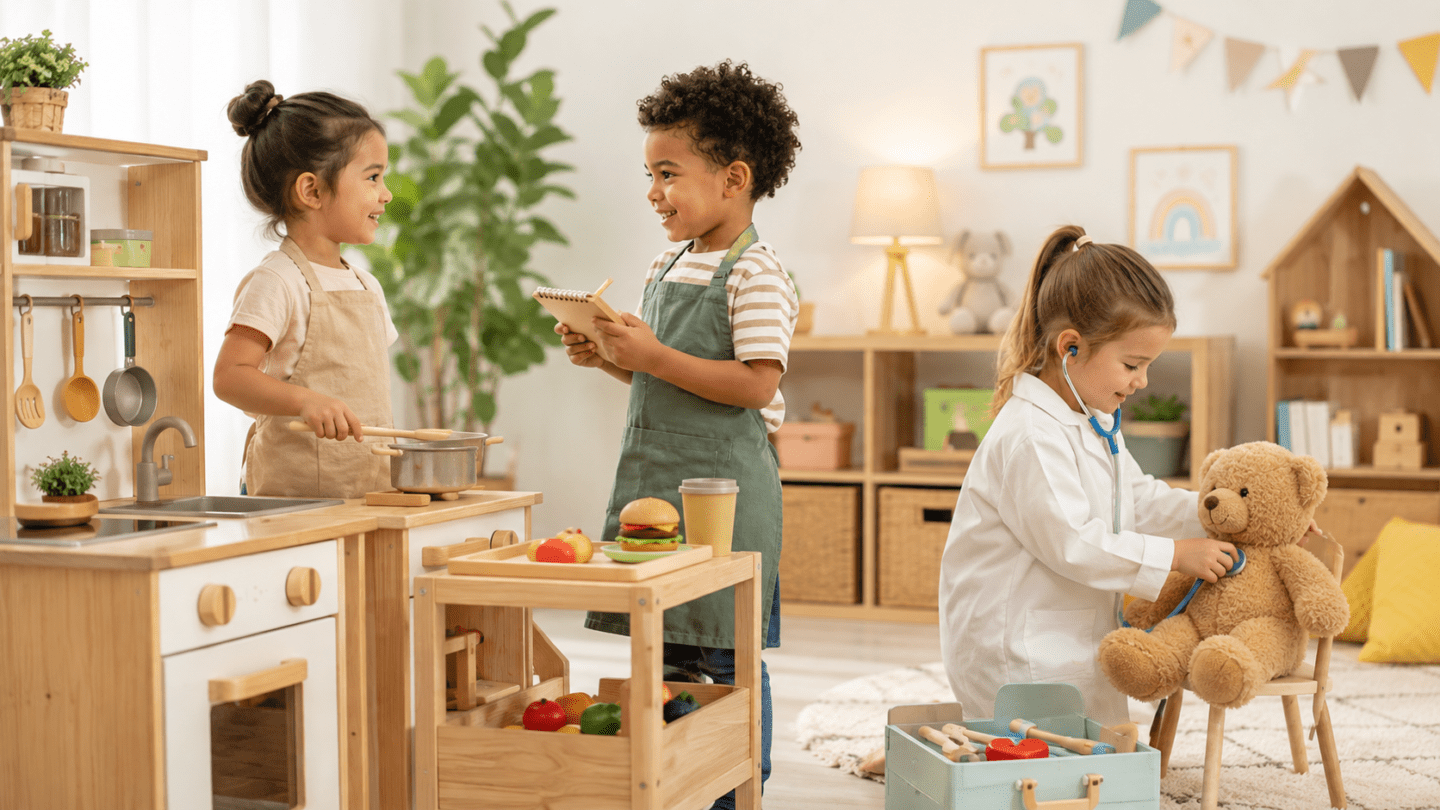
To adults, pretend play can look like a lot of noise, plastic food being served for the 14th time, and a teddy bear receiving some highly questionable medical treatment.
But while children are busy running imaginary cafés, looking after dolls or turning the sofa into a pirate ship, there’s actually loads going on behind the scenes.
Pretend play gives children a safe space to experiment with the world around them. They can copy what they see, test out different ideas, solve problems and practise social situations without even realising they’re learning.
Here are some of the biggest real-life skills children can develop through imaginative play.
Learning How to Communicate
Pretend play naturally gets children talking.
Whether they’re taking an imaginary food order, pretending to be a doctor or explaining why their dinosaur absolutely has to sleep in the kitchen tonight, they’re constantly practising communication.
They learn how to explain ideas, ask questions, listen to other people and respond appropriately. Playing with siblings, friends or parents can also encourage turn-taking and negotiation.
If two children both want to be the chef, for example, they have to work something out. Maybe one becomes the chef and the other becomes the customer. Maybe they swap halfway through. Or perhaps the restaurant suddenly needs two chefs because apparently 47 wooden pizzas have just been ordered.
Role-play toys can make these conversations feel much more natural. Things like dress-up sets, shops and wooden play kitchens give children a familiar setting that they can build stories around.
They already understand roughly what happens in a kitchen, so it becomes easy for them to recreate those situations and then add their own imagination.
Building Independence and Confidence
Children love copying adults.
Sometimes this is adorable. Sometimes it means hearing your own favourite phrases repeated back to you at exactly the wrong moment.
Either way, imitation is an important part of learning.
Pretend play allows children to practise everyday activities before they’re expected to do them for real. They might pretend to cook dinner, put a baby to bed, clean the house, go shopping or take a pet to the vet.
These little scenarios can help everyday tasks feel more familiar and manageable.
They also give children the chance to be the person making the decisions.
In their imaginary world, they decide what’s for dinner. They decide where everyone sits. They decide that teddy needs seventeen blankets and a biscuit before bed.
That freedom can help build confidence, particularly as children start becoming more independent in nursery, school and everyday life.
Developing Problem-Solving Skills
Pretend play rarely goes completely to plan.
The imaginary shop runs out of bananas. The toy car breaks down. The doll is suddenly poorly. The castle gets attacked by a dragon approximately three seconds after construction is finished.
And now somebody needs to fix it.
These little imaginary problems encourage children to think creatively and come up with solutions.
There isn’t necessarily one correct answer either, which is part of what makes imaginative play so useful. Children can experiment, change their minds and try different approaches.
This kind of flexible thinking is incredibly valuable as they get older.
Choosing toys that leave plenty of room for imagination can help too. Rather than every toy having one specific purpose, open-ended role-play toys allow children to create new scenarios every time they play.
If you’re looking for ideas for younger children, this guide to pretend play toys for 3-4-year-olds has plenty of inspiration.
Understanding Feelings and Other People
Pretend play also gives children a surprisingly good way to explore emotions.
A child playing doctors might reassure a nervous teddy. A doll might feel sad because they’ve lost their favourite toy. Two characters might argue and then work out how to become friends again.
By pretending to be different people or characters, children begin looking at situations from someone else’s point of view.
That’s an early form of empathy.
Role play can also help children process things they’ve experienced themselves. A trip to the doctor, starting nursery or welcoming a new sibling might suddenly appear in their games afterwards.
They’re effectively replaying the situation in a world they control, helping them make sense of what happened and how it made them feel.
And that’s really the magic of pretend play.
To children, they’re simply having fun.
But while they’re serving invisible cups of tea, rescuing stuffed animals and running the world’s most chaotic pretend restaurant, they’re also developing communication, confidence, creativity, empathy and problem-solving skills they’ll use throughout their lives.
So the next time you’re handed an imaginary slice of cake, accept it.
Apparently, it’s educational.