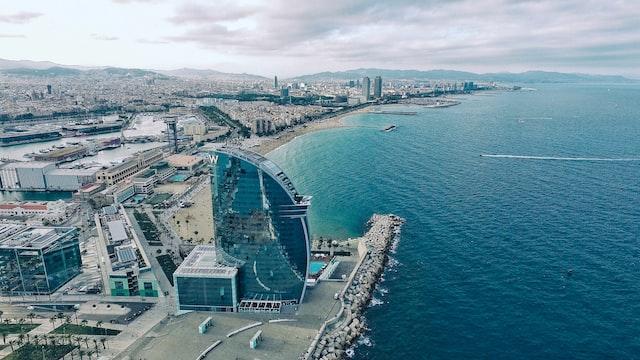
The Portal del Angel is one of the most iconic streets of the city of Barcelona; in fact, it is one of the most critical streets in Spain.
It is a commercial artery with the most expensive rents in the country, ranking fourteenth in the world, as the square meter can cost more than 3,400 euros.
Today, the Portal del Angel is dominated by the best and most important clothing stores, the most internationally recognized companies, hundreds of prestigious stores, and even the best Spanish schools (if you want to learn more about Spanish in Barcelona, you can click here).
However, everything was very different a few centuries ago. In the past, medieval jousting and tournaments were held in this area, and several monasteries and convents were built.
It may be difficult to imagine how El Portal del Angel was something very different from what we experience today. Something opposite to the tourist center, full of people willing to spend a lot of money, tourists and travelers from all over the world in search of glamour and sophistication. Here you can distinguish people from the higher classes, locals and foreigners who travel for work or because they want to take a Spanish class in Barcelona. In short, an exclusive and prestigious environment.
But to understand and understand this central point’s history well, we must go back to the year 1000. Let’s travel back in time and see what El Portal del Angel was like before it was transformed into one of the most elite catwalks in the world.
Some time ago…
As we were saying, in order to know the history of this iconic street, we must go back many centuries, until around the year 1000, when the city of Barcelona was just a tiny town, with only around 1500 inhabitants, that descended from the Romans and Visigoths.
It is known, from documents dating back to the 12th century, it is known that in 1146 Barcelona received land outside the perimeter of the wall, which was donated by order of the Holy Sepulchre. Incredibly, at that time, Barcelona consisted of only 12 hectares that were located inside the Roman wall. It is precisely the area occupied today by the streets La Rambla, Canuda, Plaza Catalunia, and El Portal del Angel.
Years later, monks of the Order of the Holy Sepulchre settled there, which led to the area being recognized as Villa Sancti Sepulcri. Later, the order received new donations of land; it was the land where the streets Montsió and Comtal are now located. It was there where they built the Church of Santa Anna in 1177.
The area entered a phase of expansion during the 13th century, due to the arrival of another religious order called the Friars of the Sack, who decided to tear down the old wall and build a new one.
Santa Anna, the medieval square
The Friars of the Sack came from the French Provence, and in 1262, they settled in the area after acquiring land from the noble families and the diocese of the Plaza de Santa Anna diocese. There they built their church and convent in the same place where the H&M store is now located, right on the corner of El Portal del Angel and Montsió.
Later, in the 15th century, Queen Maria of Castile and Pope Martin V reorganized the convents in Barcelona. As a result, the Dominican nuns of the Plaza de Santa Anna/Montsió moved to the neighboring convent on Santa Anna Street in 1423. From then on, the convent, which the Friars of the Sack had built, was renamed Santa Maria de Montsió, giving rise to a period of great prosperity.
Since then, not only the convent located there, but also several noble families who decided to build their palaces in the area, such as the Perelada, Albi, Soterra, Cruilles, the Marquises of Vilana, Santa Pau, Barbara, and the Cardona, which was the most distinguished and essential house in Spain.
During the VX century, the space between the Plaza Santa Anna and the streets Arcs, Cucurulla, and Comtal was used to hold parades, where the criers were heard and the fanfare of trumpets and drums.
Period of wars and exclaustrations
During the 17th and 19th centuries, there were many wars between France and Spain, so the convent of Santa Maria de Montsió suffered several bombardments and exclaustration. Although the Dominican nuns managed to survive all these misfortunes, their convent was confiscated by Napoleon in the 19th century, and then the same thing happened during the Liberation Triennium.
Santa Maria de Montsió was saved from what became known as the “Bullangues de Barcelona” (the burning of convents), but despite this, the building became a military barracks, and the nuns had no choice but to leave.
The Liceu
The military men who lived in the convent needed to raise money, so they created a company that would gather the fans to sing. For that reason, they built a theater inaugurated in 1837, when it celebrated its first performance. That was the birth of the Liceo Filodramático de Montesión, now known as the Gran Teatre del Liceu.
During the reign of Isabel II, the building became a public school for singing, dancing, violin, and fencing, and it also had its orchestra.
However, in 1842, the Liceu was bombed. It is said that at that time, more than a thousand shells fell on the city due to the uprising that occurred against Espartero. When Espartero was expatriated, the government ceded the convent of the Tinitarios de La Rambla to the Liceu so that they could build the theater there, which was inaugurated in 1847 on April 17.
A unique place
Historians say that El portal del Angel is a place where everyone has left their mark, from Los the Friars of the Sack to H&M. It happens that this is not something that usually happens; it is not easy to find another place in the city of Barcelona that can be rebuilt with such precision throughout history, and even less so with so many essential and well-preserved architectural elements.